
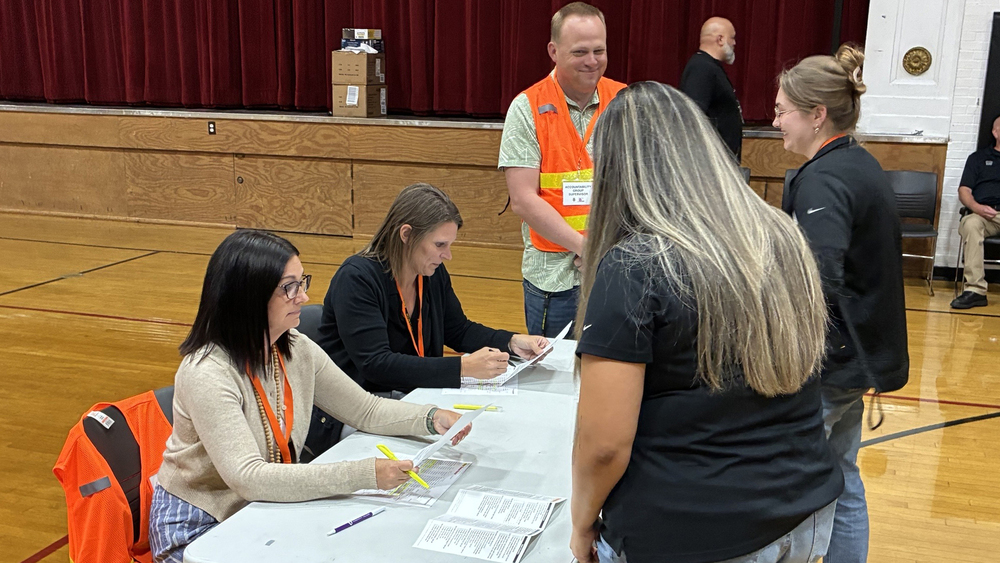
What happens when a crisis happens in a school, how does staff respond, and how are students safely returned to their families? This summer, all Harvard Community Unit School District 50 administrators took part in an intensive School Safety and Violent Event Incident Management (SSAVEIM) training, a nationally recognized course led by the Illinois Fire Service Institute to learn those answers and how to best put them in action.
The eight-hour training included educators and public safety professionals from McHenry County fire, police, and EMS agencies. With an emphasis on incident management principles, including command, coordination, communication, collaboration, and resource management, the course focuses on preparing school personnel with the skills necessary to manage potential crisis scenarios at schools and reunify students with their appropriate guardians.
Public safety took part in a live crisis simulation where they coordinated resources and response in real time. District administrators led the reunification effort, acting out the roles necessary to match and release students and guardians.
“As a district, we are always looking for opportunities to improve and refine our safety and security practices to ensure the best outcomes for our students and staff,” said Superintendent Brandon C. White. “In the event of a crisis, I want families to know that our staff is equipped to put nationally recognized best practices like SSAVEIM into action.”
Districtwide safety and security enhancements are just one part of a detailed preparedness process that has positioned District 50 as a regional leader in student safety. Under the guidance of Justin Leibach, Director of Safety and Security, district staff has taken part in rigorous training opportunities while the district has forged strong relationships with local, regional, and national public safety agencies. Leibach in collaboration with the Regional Office of Education secured a state grant that covered the cost of the SSAVEIM training.
“The biggest takeaway was the relationships we built,” said Leibach. “Training in a multi-disciplinary environment with law enforcement and fire in a hands-on setting showed us how well we can coordinate when it matters most.”
District 50 recently adopted the Comprehensive School Threat Assessment Guidelines (CSTAG). CSTAG training gives staff the skills to recognize a potential threat to self or others and support students with the necessary interventions, while maintaining a safe school environment.
Last winter, District 50 hosted a regional safety reunification training that brought together McHenry County school districts, all D50 administrators and emergency response partners for hands-on emergency training. Leibach, other McHenry County School Safety Directors, and the Regional Office of Education served as founding members of the McAid Alliance, a mutual aid agreement modeled on the framework created by police and fire departments to respond during a crisis.
“Our work with the McAid Alliance and the Regional Office of Education keeps us connected to what's happening across the county,” added Leibach. “We aren’t training in isolation. We're building a regional response plan together, and that work is ongoing.”